


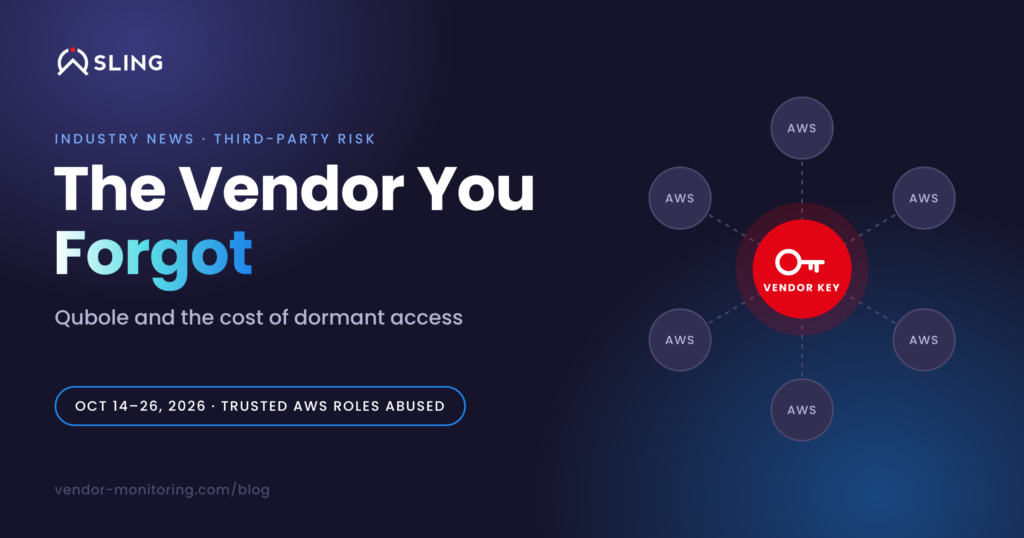
Between October 14 and 26, 2026, an attacker used credentials from data platform vendor Qubole’s Amazon Web Services (AWS) account to walk into the cloud environments of dozens of its customers, many of which had stopped using the service. The lesson is about vendor offboarding: access granted to a vendor stays open until someone closes it. On November 12, Expedia confirmed that attackers reached its systems through a compromised third-party data platform provider.
The short version for third-party risk teams: the contract ended, the access didn’t. Nobody broke a lock. The attacker used a door the customers had built for a vendor and never removed.
Key takeaways
- An attacker abused Qubole’s trusted AWS account to assume roles in customer environments from October 14 to 26, 2026, according to Wiz.
- Many of those roles belonged to organizations that had stopped using Qubole, which makes vendor offboarding a security control, not an admin task.
- Expedia confirmed a breach through a compromised third-party data platform provider but hasn’t named the vendor or confirmed any figures.
- One vendor credential reached dozens of companies, a textbook case of concentration risk in the software supply chain.
- Risk teams should inventory every live access path a vendor holds, including for vendors that are no longer active.
What happened in the Qubole supply chain attack?
Qubole is a cloud data platform. To let it process their data, customers created cross-account Identity and Access Management (IAM) roles in their own AWS accounts. A cross-account IAM role is a permission set that an outside account, here Qubole’s, is trusted to use, usually gated by a shared value called an External ID.
What has been confirmed
Wiz reported on November 9 that a threat actor used IAM credentials from Qubole’s AWS account to assume those integration roles. “Every AssumeRole request we attributed to the threat actor included an External ID, and every one succeeded,” the Wiz researchers wrote. The research was done with Sentra and Mandiant.
Once inside, the attacker enumerated storage, databases and IAM resources, then harvested secrets from AWS Secrets Manager, AWS Systems Manager (SSM) Parameter Store and Lambda environment variables. BleepingComputer reported that the attacker used TruffleHog to validate discovered AWS keys, Microsoft Entra ID client secrets and Okta client credentials.
Sentra, which first spotted the activity, said about 100 passwords and keys were read in 7 minutes. At one company, millions of files were downloaded, including production database backups.
What hasn’t been confirmed
How the attacker got Qubole’s credentials hasn’t been disclosed. Qubole had not issued a public statement when BleepingComputer published. AWS said its services “were not compromised by this issue and operated as designed.”
Wiz noted that a group calling itself n0n claimed responsibility, a claim Wiz has not verified.
Who was affected?
Sentra said “dozens of Qubole customers were impacted.” No official list exists.
The best-known name so far is Expedia. According to Skift, Expedia said it is “aware of a supply chain attack, reported by security researchers,” contained the issue and is investigating with outside experts. Expedia hasn’t named the vendor. Forbes and others link the incident to Qubole, but that link comes from press reporting, not from Expedia.
The n0n group claims more than 830 million loyalty program records and 333 million account and credential records. Expedia has not verified those numbers. Treat them as an extortion claim until proven otherwise.
Why does the Qubole attack matter for third-party risk management?
The Qubole supply chain attack is a vendor offboarding story more than a cloud security story. Third-party risk management (TPRM) usually focuses on vendors you rely on today. This incident hit the ones customers thought they had left behind.
A finished contract is not a closed door
Sentra found that “Qubole roles were still in place long after companies had stopped using Qubole.” The roles were dormant, privileged and trusted. In most affected environments, Wiz saw no legitimate Qubole activity in October at all. The only vendor traffic was the attacker’s.
Concentration turns one stolen key into dozens of breaches
One vendor account trusted by many customers is a single point of failure. A provider with broad, standing access to customer data deserves a high risk tier even when its invoice is small, or zero.
Questionnaires don’t see access you forgot
A security questionnaire asks a vendor about its own controls. It doesn’t ask you which of your systems still trust that vendor. Point-in-time reviews also tend to stop when a vendor is marked inactive, which is exactly when this risk starts to grow.
Your vendor’s compromise becomes your incident
Customers did nothing wrong in the moment. The integration worked as designed. The exposure sat in the gap between the procurement record (“ended”) and the cloud configuration (“still trusted”).
What does good vendor offboarding look like?
Vendor offboarding is the process of ending a vendor relationship safely: removing access, recovering or deleting data, and confirming both. Most programs treat it as a contract step. The table below shows the gap.
| Offboarding step | Common practice | What the Qubole attack shows is needed |
|---|---|---|
| Contract | Terminated, archived | Terminated, plus an access checklist signed off |
| Cloud trust (IAM roles, keys) | Left in place | Removed, with the External ID retired |
| Secrets the vendor could read | Unchanged | Rotated |
| Data held by the vendor | Assumed deleted | Deletion confirmed in writing |
| Monitoring | Stopped | Continued until access is proven closed |
What can continuous monitoring do here, and what can’t it?
Monitoring can’t see your own IAM trust policies, and it can’t stop an attacker who holds a valid vendor credential. Those controls live in your cloud account.
Continuous vendor monitoring can still help. It keeps vendors, including dormant ones, in view, and it can surface signals such as leaked credentials, compromised accounts or a vendor appearing in darknet chatter before an attack lands. Wiz also saw a separate wave on October 8, when customer-owned AWS keys created for Qubole integrations were tested within one hour. Early signals like these are worth catching.
What should risk teams do this week?
- Search for Qubole trust. Ask cloud teams to find any IAM role trusting AWS account 805246085872 and review CloudTrail from October 1, 2026, as Wiz and BleepingComputer advise.
- Rotate what the role could read. Removing a role doesn’t end sessions already issued. Rotate secrets and revoke active sessions.
- List every integration with standing access. Include vendors marked inactive in the register.
- Add an access check to offboarding. No vendor closes in the register until cloud trust, keys and API tokens are confirmed removed.
- Tighten live vendor roles. Restrict them to the vendor’s published network ranges and the data it truly needs.
- Re-tier vendors with broad data access. Access and data reach should drive the tier, not spend.
Where Sling fits
Sling was built for an outside-in view of vendors. The Sling Score combines darknet and cybercrime intelligence with attack surface mapping, and alerts flag events such as leaked credentials or a vendor showing up in ransomware chatter.
There are limits. Sling won’t see the IAM roles inside your AWS account, so offboarding still needs a cloud access review. What it can do is keep every vendor, active or dormant, under watch, and Sling Ray maps the wider supply chain without questionnaires or agents.
Bottom line
The Qubole supply chain attack didn’t need an exploit. It needed access that outlived the relationship. Vendor offboarding belongs in the security program, with the same evidence standard as onboarding.
CTA: Want to see which of your vendors, active or forgotten, show exposure from an attacker’s perspective? Get their external risk and darknet signals, starting from a single domain. Request a vendor risk assessment
For more background, read our guide to software supply chain attacks and our analysis of the IDCF Cloud ransomware attack.
FAQ
What happened in the Qubole supply chain attack? An attacker used IAM credentials from Qubole’s AWS account to assume trusted roles in customer AWS environments between October 14 and 26, 2026. The attacker stole secrets and downloaded data from dozens of companies.
Was Expedia hacked through Qubole? Expedia confirmed attackers reached its systems through a compromised third-party data platform provider but hasn’t named it. Press reports link the incident to Qubole, and Expedia hasn’t confirmed the claimed record counts.
Why is vendor offboarding a security issue? Access granted to a vendor stays active until someone removes it, even after the contract ends. In the Qubole attack, roles left behind by former customers gave the attacker a ready path to their data.
Could continuous vendor monitoring have prevented this? Not on its own, since the attacker used valid vendor credentials inside customer cloud accounts. Monitoring can surface early signals, such as leaked credentials, and keep dormant vendors in view so offboarding gaps get noticed.
What should companies that used Qubole do now? Remove any IAM role trusting Qubole’s AWS account, review CloudTrail from October 1, 2026, and rotate every secret those roles could read. Revoke active sessions too, because deleting a role doesn’t end them.
Sources
- Wiz, Trusted by Default: Qubole Cross-Account Access Abused in the Wild, November 9, 2026 (updated November 11, 2026)
- Sentra, Inside the Qubole Supply Chain Attack, November 9, 2026
- BleepingComputer, Hackers exploit trusted AWS access to breach multiple cloud environments, November 10, 2026
- Skift, Expedia Confirms Cyberattack Through Third-Party Vendor, November 12, 2026
- Forbes, Russian Cyberattackers Hit Expedia, Claiming Nearly A Billion Traveler Records Exposed, November 13, 2026